Trucksafe LIVE! Virtual EventFree
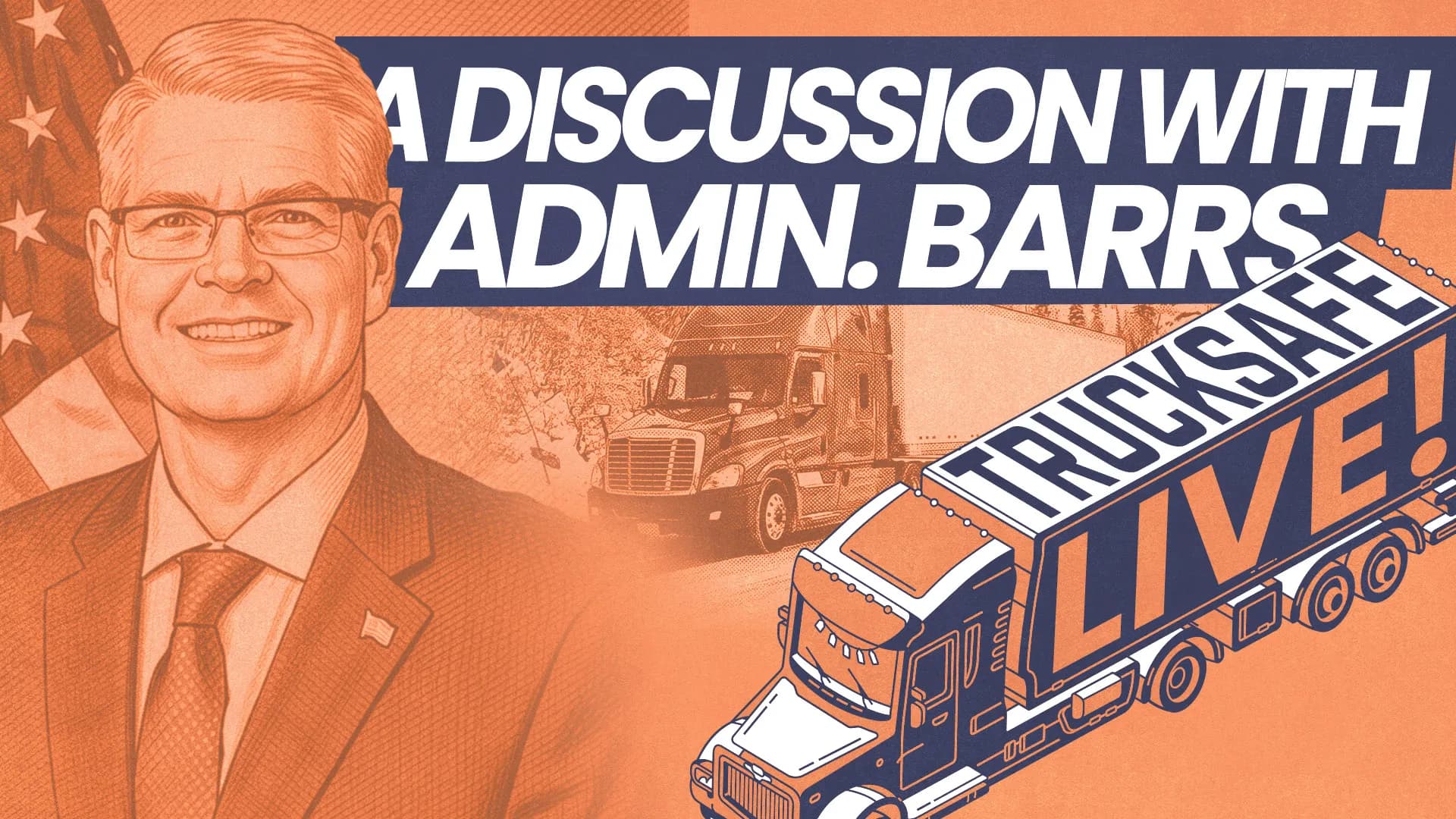
Trucksafe LIVE! | Ep. 63 - A Discussion with Administrator Barrs
Monday, July 13, 2026 at 1:45 PM EDT
About This Event
In this episode, we’re joined by FMCSA Administrator Derek Barrs to discuss the agency’s regulatory and enforcement priorities, the status of the MOTUS rollout, and more!
Guests
Watch the Recording
Episode Summary
In Episode 63 of Trucksafe LIVE!, hosts Brandon Wiseman and Rob Carpenter of Trucksafe Consulting sit down with FMCSA Administrator Derek Barrs for a wide-ranging conversation on some of the most pressing issues facing the trucking industry. The discussion centers primarily on the agency's rollout of its new registration system, Motus, which has experienced significant technical difficulties since its Phase 2 launch. Administrator Barrs acknowledges the challenges openly, attributing many of the issues to decades of fragmented legacy data across seven separate FMCSA databases, some containing records dating back to the 1960s. Despite the rocky transition, Barrs emphasizes that modernizing the registration system was not optional and that the agency is meeting twice daily to address outstanding issues on a sprint basis.
Administrator Barrs provides important guidance for carriers and brokers experiencing problems with the new system. He notes that carriers who are currently showing active in the system and have no insurance issues are not required to proactively migrate into Motus at this time and can wait until their next MCS-150 update. For those experiencing difficulties, he encourages them to contact the agency directly or work through industry associations to submit batched issues for resolution. He also confirms that some carriers being blocked by the system are encountering intended friction, as the system is functioning as designed to flag incomplete or inaccurate information, a key feature aimed at combating carrier fraud, identity theft, and chameleon carrier activity.
The conversation also covers enforcement priorities, including the agency's ongoing removal of non-compliant electronic logging devices from the self-certified list. Administrator Barrs signals that future removals will be far more extensive than the recent batch of ten and reaffirms the administration's intent to eliminate the self-certification model entirely for both ELDs and entry-level driver training providers. He describes active rulemaking efforts in both areas and points to Canada and the UK as models the agency is studying as it considers third-party certification frameworks. Barrs also confirms that investigations of entry-level driver training schools are actively underway and will continue to ramp up.
Among the actionable takeaways for fleet safety professionals, Administrator Barrs and the hosts stress the critical importance of participating in the FMCSA rulemaking process by submitting comments during notice of proposed rulemaking periods. Barrs explicitly invites industry feedback on issues such as behind-the-wheel training requirements, online versus classroom instruction standards, and ELD certification processes, noting that every comment submitted is reviewed. He also encourages carriers experiencing Motus-related issues to contact the agency's call center, which has been expanded and now operates seven days a week with extended hours.
On broader agency matters, Barrs addresses the state of FMCSA's MCSAP partnerships, describing strong collaborative relationships with state enforcement partners and ongoing joint operations. He also touches on other unified agenda priorities, including changes to the safety rating process, new entrant safety audit standards, and CDL licensing reforms, including a push to require both written and practical CDL testing to be conducted in English. Throughout the conversation, Barrs expressed his interest in transparency and urgency, encapsulating his approach with the acknowledgment that the agency has "bitten off more than it can chew" but remains committed to continuing to work through the challenges in the interest of highway safety.
Full Transcript
Heat. Heat.
Heat. Heat.
Heat. Heat.
Heat. Heat.
If you're like us, you're probably tired of flipping through outdated and expensive regulation books and struggling to understand the rule or guidance you're after. E-Riggs is the first web and mobile app version of the Federal Motor Carrier safety regulations, helping fleets of all types and sizes better access and understand their regulatory obligations. is always up todate and allows fleet safety professionals to not only read the rules, but also dig into FMCSA guidance and learn more about complex regulatory topics from industry experts. Highlight, bookmark, and take detailed notes right from the app and access them on any of your devices and easily share a digital version of the regulations with your drivers so that they too can better understand the rules. Was developed by safety professionals for safety professionals. Try it out for free at e-regs.app.
All
right. Hey everyone, welcome to episode 63 of Truck Safe Live, the show where we and our guests tackle the hot button issues impacting highway transportation. I'm Brandon, that's Rob. We're with Truck Safe, uh, dedicated to helping motor carriers develop and maintain cutting edge safety programs. Rob, what's going on? Not a whole lot. How's it going? It's going well. It's been a while since we've done a show. Anything new in your world? I mean, there's a lot new in our world. A lot new in your world. Yeah, that's for sure. But, uh, just trying to survive summer here. It's like 95 degrees today here in Indianapolis, so it's getting a little warm. Yeah. between the uh the bad truck cases you've got in Indiana and the bad weather you've got up there is like killer both ways. Yeah, you always like to bring the the bad news into it though. So, I appreciate that about you. You know me, the pessimist always. [laughter] All right. Well, we've got an exciting show today with a special guest joining us. So, we're going to skip over our usual pleasantries and move straight into the topic today. And uh to do so, we're super excited to welcome FMCSA's administrator Derek Bars to the show. Ministry Bars, welcome. Well, it's good to be with you, fellas. Glad to be here. How are you today? Good. Doing okay. I I'm doing good. I mean, I was uh I'm kind of liking a little bit of warmer weather. It makes me feel like I'm back home in Florida, I'll tell you. So, I do I do like that. Well, I mean, here in Virginia, we we're not as muggy as Florida, but we're close. [laughter] I know. I went home over the holiday and it was just great uh to walk outside and start sweating to death, so it was great. [laughter] Yeah, this is the time of year you never want to go to Louisiana or Texas or Florida or any of that. So, yeah, usually this time of year, we find ourselves at Disney World for some reason and it ends up being 105 or something and kids are all going crazy and it never stops raining. I don't get it. I mean, Florida, every time I go to Florida, it rains and it never stops. Oh, it was bad. This past couple of weeks, it's been terrible. I was in Texas last week and they said, "Well, you know, the humidity is not that bad. It's just uh it's just a different type of hot." I said, "It's hot." I mean, it's like walking in the oven, but it's a dry. I like it. It's good. Makes you feel like you're home. [laughter] Yeah. Well, administrator Bars, like I said, I really appreciate you joining us, taking some time out of your schedule to, uh, to hop on here. I know there's a couple of items you wanted to hit on. So, uh, starting things off, I know I think the last time you and I talked was at Matts earlier this year in Louisville. And uh at MATS, we heard the agency talk a lot about its modus uh system and the plan to kind of modernize the FMCSA's registration process. And you know, since then, I think the agency has launched what it calls phase two of Modus. And um I don't think it's any secret. It's been a bit of a rocky transition. And so that's what I wanted to ask you about kind of what what the overarching goal is with Modus and where do things stand currently. Well, first of all, you're absolutely right. uh we I think in some of our pre- discussions that we had that modus is not exactly where we want it to be by any stretch of the imagination. Um and we are continuously working on uh where we need to be with modus. Um, you know, this is a system and something that was mandated back decades ago, I think 2012 and even before that where we needed to have this new registration system and it's been kicked kicked around and we kicked the can and so forth for many years and not wanting to roll it out. There's different companies that said, you know, this is a little bit more difficulty. It's more difficult than what we wanted and we're just basically going to pull out. We don't want to have anything to do with this about merging the seven different databases that FMCSA has. Um and I I have this this system is old. It's failing and we all know that. Uh I'll give you one classic example about this the uh the MIGMA system that we have. Um you all use a lot of that data whenever you're doing things for your you know your day jobs that you have being able to utilize utilize a lot of the data that FMCSA has. Uh but this server is kind of in quarantine kind of make sure that it doesn't fall apart with what's um what's inside that system because we do not want that to fail even at this point. So it's handled with kid gloves is how I would say that. Um it's fragmented and this data system has been created where um we knew that it was going to be difficult. Um but I am not sorry for pushing through and doing the hard things with modus and being able to push this registration system out. Um kicking the can was not an option for this administration is not an option for me uh in this organization to be able to push modus out. Uh we are working really really hard to address the issues that we have within modus. It did like you said it did not roll out. Uh a lot of this data that we have is really fragmented. some corrupt data that came over from systems and we had data back from the 1960s that we know of uh that were inside this system. Um so you know that's kind of a high level of kind of where we are that doesn't take away from the fact that people have been disrupted and uh recognizing that u but we we are taking on this particular topic and modus is being one of them. We have a lot of other hard topics that we're taking over. I mean, I can I can walk and chew gum at the same time of of doing this, but it is I said one time in one of our press conferences that we're going to bite off more than we can chew. We probably have and we will continue to do that and we're going to keep on chewing it and chewing it and chewing it until we can try to make a difference in in the trucking industry and try to make it safe. And I believe with all of my heart by uh the what this system will be able to do when it's up and running the way it's supposed to. And I'll give some examples in a few minutes and some of your questions. I think you're probably going to have uh but we have to protect legitimacy in this industry. Uh we are seeing and we have seen where the fraud just continues to take over. Um if it wasn't for partners like we have with you and others uh across this industry to dive into this and help us try to solve some of the problems that we just were not aware of or that we didn't have the tools in our toolboxes and we have to reach out to other people that are doing this stuff. But modus going back to that modus is something that I feel like that this organ this administration we owe it to the men and women in this industry uh to make sure that it's a level playing field and modus will be able to help us do that. But you know the legacy systems that FMCSA had I can name them all to you. And one of the things I like to kind of equate this to is you know all this stuff should kind of marry together like this you know kind of do like this but it's like hitting a brick wall. Um the way the code was written you know the code was written one way back in 199 something and that stuff was not ever sunset. Um and you know then it was redone because we wanted to add another uh subset into the data. Um so it's been a data nightmare uh to say the least. But at the end of the day this has been very very hard and very difficult. Um but we continue and then we working 24 hours a day 7 days a week. I take phone calls. I had to take emails uh from people personally to be able to push this thing through uh to be able to get people back up and running and solve the issues that they have within Modus. Um so I'll stop right there. That's a lot of rambling. Um but I just kind of wanted to hit on those [clears throat] high points. Yeah, you mentioned uh legitimacy and um kind of making sure that the data and the systems does its job uh at least one of its jobs of helping not only the agency but others in the industry try and uh weed out fraud and also bad actors and obviously this wasn't within the agency's control but kind of the timing of the roll out and the IT issues that ensued wasn't great when you look at the Supreme Court's decision in the McGomery uh in the McGomery case kind of placing placing the national spotlight on the data more so than ever. And so, you know, we've seen third parties and and brokers, property brokers out there report some data anomalies in the new system. You know, for example, some carriers showing authorized when in fact they aren't and vice versa. And uh there's there's just a lot of eyeballs on the data. And so, what's your recommendation to those that are relying on the data to make their business decisions, primarily the property brokers in light of Montgomery? So I'll tell you that the modus system right now will show a carrier who is active in some cases not all cases and then downstream in Migmas and Modus and then some of the T U hubs or some of the hub systems that we have where the state utilizes that will be off. We recognize that um there have been the team has been working to address that. So if there's a change that's been made in modus then it goes directly downstream. Um, I would just ask that they would just continue to call us, you know, get get online. We have upped our uh call center uh folks, you know, additional people that are coming in there. We're working seven days a week inside there. We extended the hours. Uh, they can reach out to uh us at FMCSA uh directly um to be able to answer these questions that they may potentially have. Um, I feel very confident based off of we meet twice a day uh internally uh with our technology teams. We meet in the morning, we meet in the afternoon. We're working on sprints of being able to go through and address these issues that are hot button. I call them kind of gushing issues that we have got to stop the bleeding, if you will, on those issues. And it is getting better. We're seeing a reduction in um in our our number of tickets that we have that are coming in. a lot of these tickets that when they come in, so if you have x amount of people who are calling in, we have them narrowed down to a smaller bucket of issues that we are uh tackling from an IT perspective. You know, you know, I'm just going to use these numbers as just kind of a understanding. If a 100 people call in, there may be 75 issues of the same 100 people calling in. So if I fix that one issue, it's going to resolve 75 people's problems that they have coming in. So trying to make sure that we continue to stop that bleed and that triage and then on the back end really working with our data uh to making sure that that's clean data is coming in properly. And I'll give you one example. I didn't realize this have was happening. This was this caused a major issue. Phone numbers for example from the old system there was no it was not categorized for example for you know if you put a 1800 555 555 you know you'd have parentheses around it. Well before in the old system you could put as many numbers as you wanted into it. It didn't make any difference. Well in the new modus system it matters and so that data gets clogged at the front door. So there was a lot of those issues that were uh like that that were occurring uh as we've gone through this that even though through the testing and the multiple testing that we did was not able to be seen. Um but you know we're we're going to get there. I don't want people to be out of work. The agency does not want people to be out of work. The administration no one wants any of that whatsoever. um that you know this industry means so much to me personally uh to make sure and so this this is something that is very very hard it's been very difficult as I can continue to go back to um but we are going to make the differences that or make the changes that need to be made and we're working to make sure that we do that kind of along the same line obviously Rob and I work primarily with motor carriers and so we've got a lot of clients um who have reported uh some delays in trying to like get new authorities, like if they're trying to apply for a new authority, they've um been blocked out of that for a while and and are having trouble getting through some of the backlogs. Is the advice to them similar to the advice on the broker side of things, which is to get in contact with the numbers that are available and uh and hopefully those wait times start to come down and they can get their their questions answered. Yeah, that that is true. And you know, sometimes if we get a large number, the folks that will come in, I can address those. I just give you notes. Some of the associations for example they people who are part of those else they they'll send us over a batch if there happen to be 10 or 12 or whatever and we can work through those. Uh a lot of them are the same issues so we can work through those individually. Um but I would ask that they would continue to do that if they have a mechanism to uh give us a batch of these things at one time then we can address them is is one option as well. Um, but we are enhancing our call centers as I mentioned. We are enhancing our chats. We are enhancing ways uh that you will see online on the Modus web page to be able to get people the answers that they need. And I do appreciate people being patient with us. Maybe some not so much, but I do appreciate them being very patient with us and understanding that we have tackled something that we just could not continue to kick down the uh down the road. One thing I haven't been entirely clear on, maybe you can help us clear it up, and you mentioned Mickmiss earlier, is the extent to which the modus roll out is tied into other agency systems, namely its enforcement systems like Mickmos and SMS and data cues and stuff like that. I've heard some rumblings about clients having some trouble even using those systems like um even today I had trouble logging into SMS for some reason. But I don't know if that's tied into the modus roll out or if there's some other explanation for those types of things. I don't know why that specifically that you'd have problems not being able to get into SMS necessary or you're trying to log into a system that you would normally have. Um I can I can surely look into that too if that's something that you're having problems with or there's others having problems with. I'll take that down as a uh as something to to follow up on for sure. No, I appreciate that. I just didn't know if it if it played into the modus if that was also affecting these other systems or if if that's not the case. No, I'm I'm not familiar with that if it is, but I I can surely follow up just to make sure uh and we can we can correct that. There's one thing I I did want to just kind of put into context. You know, when we started rolling out modus, uh we sent out 2.2 million letters to individuals to say modus is coming. you know, if you want to go in at some point, you're going to need to update your information. This is the process. This is how bad some of the data is. Uh, and people not doing what they're supposed to be doing. And rightfully so. There's probably some that were, you know, over years of having DOT numbers that these people have gone out of business. But 450,000 of these letters came back to us as undelivered. Wow. Um, so that let me know that whether you're in business or you're not, if you're out of business, but if you're actually in business and you re and those letters were returned back to us, that let give is a big sign to me of what I already knew, but it just codified that or it it showed me what I actually knew where there are folks that are not doing the things that they're supposed to do when it comes to registration when they're not updating on a timely manner like they're supposed to. Um, and I will tell you that when we work through our our registration uh rule making that those are areas of where we're going to be tightening up. If you're not in the system and if you're not updating your system the way you should be, then you should be out of service. Period. And there shouldn't be this inactive piece and all that. I think you should be out of service. It makes it very very clear where where you stand in in in uh being able to operate or not if you're not going to follow those rules. And for the people that are following the rules and doing the right thing, I don't think that's going to be an issue. they're going to do the things that they're supposed to be doing. Um, and then other part even through the new motor system that we have right now, we have identified multiple multiple uh times where people were fraudulently using passports, fraudulently using credit cards to pay from overseas operations and these are criminally being investigated now. uh we will continue to take that route as well of identifying this and vetting these out but the system is working and doing the things that it's supposed to um already and I am so happy to hear that uh when I got an update at the end of last week on some of these things that have been coming through. Uh some folks are actually uh when they go in I've gotten calls saying well I can't get into the system or I can't do this or I can't do that. It has absolutely nothing to do with the motive system not functioning properly. It's actually functioning the way it's supposed to, but people are not answering the questions properly. Does that make sense? So, there are some of these things that you it's doing its job by keeping you out until you do XYZ. Yeah, that I think that's a good thing. Yeah. Yeah, when Rob that's something Rob and I encounter quite a bit is um despite all of the warnings that went out. I mean, we tried to publish it to all of our clients as well that, hey, this is coming. Here's what the FMCSA is recommending you do. Get log into your portal account, update your company official. Despite all of those warnings, we have, as you mentioned, all kinds of carriers that haven't logged in. And so, one piece that I don't think they realize that has been implemented with this roll out is a new uh identity verification system that they're going to have to go through some hoops to try and clamp down on some of the fraud that you mentioned. Um, but also in terms of those folks who haven't taken the initial steps that that were recommended to get themselves set up, can you kind of walk us through what your what the recommendation is? They need to go into their account still and get the right company official and the right contact information up to date in the system. Is that is that it? Yeah, they'll need to claim their account, but if they are everything is showing good at this point and they're in the system and they're showing fine, um, I don't have a problem. We don't have a problem at this point saying, "Okay, you don't have to update any information in your account." Then fine, don't go into the mode system because everything you see right now is showing active and you're not having any insurance problems. You don't have to update anything related to insurance at this point in time. You can stay where you are and then move over when it's time for you to actually update your MCS150. Um, there's no no issues with that whatsoever. So I I if if you don't have a problem and you're not having a problem today, it's okay for you not to move over at this point. There will come a time where you're going to want to and you need to and that's that's perfectly uh fine as well. You know, and again, we have we're trying to get to that optimal level of where, you know, we don't have the userface issues that are going on and we also don't have any of the data issues that are going on the back end. Like I said, I feel very confident about where we are right now. It doesn't mean that we still do not have issues and people are waiting to get uh uh pushed through the system and doing these things one-on-one, but there's a batch, for example, we have a batch this week that's going to clear up thousands of issues that we have right away. Um and so that's that's really really positive on my end is that those folks are not they're not going to have a problem that when they go in it'll be seamless. Um so I'm not trying to be vague on any of these questions at all. I want to make sure that people understand that and I'm trying to make sure that they understand that the fraud and abuse and the chameleons and the bad actors that are in the system through the registration process is unimaginable uh for most folks. They may not know that. I'm sure that your listeners have heard you all talk about it and what's out there. Um, but we have to do things to safeguard that and this motor system is a way for us to do that and and but recognizing that during this process we had a hiccup that we are surely not uh hoping for a lack of a better term. I think some of this has been I mean as this got kicked down the road and kicked down the road and kicked down the road I have to imagine that some of that facilitated what's actually in the system now whether it's chameleon carriers or or fraudulent bad actors. So, I have to imagine that's the case. But the second part of that is if you're you've picked this ball up, you you're running with it, we're we're going down the road. What is stability look like for you? Um and what is the timeline on that looking like and what's the outcome? What are you hoping to ultimately what should everyone know we're going to get out of this? Well, I personally think that uh you know based off of our track that where we are right now with us meeting each and every day and even on the weekends as I mentioned to go through and making sure that these things are being addressed and we're staying on top of the things and if some of the priorities actually change from our sprint levels and so forth. You know, I don't have I don't like to give arbitrary numbers about a date or anything like that. You know, is it going to be one week or two weeks? I mean, I don't think I think it's going to be longer than two weeks for us to get to a point where I'm satisfied. Um, I do think that we're going to make significant progress over the next couple of weeks of where we are. I really, really do. Um, and we'll come back and we'll sit on this show again if I need to update your folks about where we are when we'll come back and say, "Hey, this is the issues that we're having and this is how with the kind of timeline that we're looking at." Um I I would think that what what I'm wanting let me tell you what I'm wanting is uh for example our our wait times uh for example pre premotus that's where I want to get us to you know where people call in and they can get right in and they can be on the phone for 10 minutes with somebody and they can resolve their issues. Uh that's where I want us to get to. We're not there yet by any means. Uh, but we're seeing a decline in the amount of time that people are having to wait on on our calls on our call center. And a lot of that is because we're extending lines. We're extending out people that are answering those lines. Um, so again, you know, we're trying to be as customer serviceoriented as we can and being responsive to the industry uh as quickly as possible. Um, so I don't want to give an arbitrary number on that. I think my I'd be better positioned to come back to you probably in the next couple of weeks to kind of tell you where we are with that or send something back out to you in written form to say this is kind of the timeline that I think that we will have u better after the next couple of weeks of where we are if that makes sense to you all. It does. Yeah. Yeah. I appreciate that. I don't I I that's one thing I I don't like. I like fast and quick and efficient. Um and that's what most Americans I think want is fast, efficient. um and they want it to be done right. Uh and I know they're stuck in this place and that's what we want to make sure that we're we're fixing and being responsive um to the people of this country. Yeah. Um I know our our listeners will as well. Um we got you for a few more minutes here and I wanted to pick your brain on a couple of other issues if that's okay. Um I I know particularly at Matts this was very evident and even before that we had noticed this. This administration seems um hellbent on fixing a lot of the issues in enforcement that we've seen over the last several years and really cracking down in particular areas that have led to a lot of this fraud and and several serious accidents that we've seen in the news lately. And we've seen this in particular in in a couple of key areas, namely electronic logging devices with the agency having removed, I think, over 70 devices from the self-certified list in the past several months. I think 10 early uh last week and then also in the area of entry- level driver training and uh the training provider registry, the folks that are providing that type of training. Wondering if you can give us an update on both of those. As as we were talking before the show, we both know that there are still lots of issues to tackle in both of those areas, still lots of bad actors to to get out of the industry. So, I was just curious if you could give us an update on where both of those things stand. So I I will touch on all of those. So let me touch through it's only what's on the unified agenda when it comes to rulemaking pieces real quick which actually going to tie in to a lot of the questions that you just had. But uh the non-domicile we've already pushed through. Uh the English language proficiency out of service being codified that into rule um is is I've had a meeting on that this past week again and we're just our rulem team is working on all of these to get them out the door from a notice of proposed rule making process. Entry level driver training and that's going to strengthen up the the way that the entire entry level driver training um is done. Now, some of your folks, I actually looked at some of the comments that you all have about when you were advertising this particular segment about asking me hard questions and all that kind of stuff. Ask away. I don't I don't I can take the hard question. And I've actually reached out to some of those folks as well uh on the side to say, "Tell me what it is that you want us to to look into. What is it that you want us to uh to do and change in the rule when it comes to behind the wheel training? the types of training that needs to be done from a classroom setting compared to what you can do online. What does that look like? I want all of those things. I want people to give us every single thing that they can think of to make sure that we're strengthening up the entry level driver training piece. I'm not going to shy away from any of this stuff. This stuff is difficult is it's hard as we talked about a while ago, but what are those requirements going to look like? and I need everyone's help to be able to give us that information and not be hiding behind or telling me that I'm not going to answer the hard questions. Well, that's pure false. Just to lay that out there just to tell you. I'm glad you did cuz if you didn't, I was going to say the same thing. [laughter] So, I and I am just as frustrated as those individuals are frustrated the way this system works. The self-certification process does not work. If there's not anything that I do in the next ever how long I'm here and fortunate enough to have this job, we're going to get rid of the self-certification process. And entry- level driver training piece is one of those. The ELD piece is the other uh that we have got to get away with get away from and we're going to and that's what this rulem process that we have um is is going to help us do. Now with that being said, now we have to start working on what those what does it look like? If it's not going to be self-certification, how do we get to a point where we are actually satisfied and we agree to how the third parties are going to potentially verify labs are going to verify for for example for entry level or for ELDs. Uh how do we ensure that when we have a new device that comes in from ELD that that device is not going to be able to be manipulated? is not going to be able to follow the standards that we expect from an hours of service standpoint because you know hours of service whether it's paper logs or whether it's ELDs is it is designed to ensure that you're tracking and not keeping people on the road and holding people accountable if they're over their hours of service period from a safety standpoint. I don't need people manipulating a paper log and I surely don't need you manipulating a um an ELD. To be able to allow individuals to continue to drive is absurd. You're putting people's lives at risk. And we've already seen this over the last few days or the last few weeks where we've had these multiple crashes that have killed people that have been all over the news that are tied to each one of these categories that you're bringing up. And it it's like people just don't give a damn. Yeah. Yeah. And I don't And I don't I cannot wrap my head around it for to save my life and I I've said this before and I'll say it again and again. If you don't want to do the things right and try to do the things right, then do something else. I just I just it just Anyways, I'm on my soap box about that and I apologize, but really I really don't. But it's just how can we not know that these are issues? Yeah. Well, and the other piece to that is to to your point, administrator bars, it's like you need people to that are experienced in this industry that know particular areas of it really well to to give you the information you need to to do your job. And you ask so many of these people, they get online, they complain about everything, and then you ask them, did you participate in the rule making process? Did you submit your comments? Did you submit your data? And the answer is almost always no. So, I want to remind people that when you guys propose rules, it behooves them to get into those dockets and submit whatever data they have, whatever comments they have, because you guys actually do consider them. We've seen this ourselves. We've submitted comments to a lot of your rules and give you the information you need to make an informed decision because if you don't get that information, you're going to make the best decision you can based on the available information. So, I think that's a a important reminder for folks as well. I 100% we whether it's one comment or 10,000 comments we have to look at every single one of them and every single comment that we get can be hey have you considered this have you thought about this how how would you do this is what I would do and a lot of a lot of times it's kind of like when you start talking about motives when you're talking about issues you start pulling those issu issues together you see oh wow okay there's a lot of commonalities here these are things that we need to consider when we start developing out this rulemaking I want to tighten this up just as much as anybody else does. I don't want to be able to just put people behind the wheel and willy-nilly and just doing things just to be doing it. That doesn't make any sense, you know? Yeah. I want to be compassionate. I want to be com I want to be uh making sure that we are responsible to doing the things that we need to be doing. And I want us to be the best that we can be. And the only way we can do that is by strengthening up the things that you're talking about. you know, this is a really, really good industry um of people who are really doing the right thing and trying to do the right thing, but there's this segment of folks over here that are not, and that's the ones that we need to make sure that we're focusing on and that we target to to get you out of the industry if you're not complying with the rules and regulations. Uh we're we're doing investigations right now uh of entry- level driver training schools, and that is only going to ramp up. I'm [clears throat] just going to go ahead and lay that groundwork to folks that are listening. This is only going to ramp up um to ensure that you are compliant. You most likely are probably going to see me knocking on your door at some point. Um I I plan to do that. The the other folks in the front office, we plan to be boots on the ground and seeing these things through because it's that important. Um, so I'll talk about entry- level driver training. We talked about that. And then your uh for ELDs, for example. Um, the ELD, we're really coming along uh good uh with our rulemaking process. I met last week again. We we meet consistently and making sure we're meeting our metrics of where we need to to go when it comes to pushing out these notice of proposed rulemakings. Um, but there are others that have had inactivity. Uh, they're not, you know, operating. uh we have hundreds of those. So I suspect the next list that's going to be coming out, the people that are removed is going to be a lot more than just 10. Um so we're going to be working to remove others that are not either active or not doing the things that they they they should be doing. We're going to continuously vet these uh ELDs until the actual rule is changed. Um and and with that with the rule change, again, comments are very very important. uh and what that looks like as we strengthen this piece up. You know, if I have my way about it, if you're I don't know what the timeline is going to look like, but if you're in the system today, you'll have some sort of time period that well, you that basically just sunsets and you go and have to reapply uh to be a have be an ELD provider at some point with some kind of third party certification or something. Correct. Yes. Absolutely. Yes. Yeah. I know I know in the UK we got we've got clients over there and when you when you're looking at the UK's system they're tacks there's only like three manufacturers over there that can put these things out and when you use them your your your document goes in it knows who you are there's no question about who manufactured the system who's driving the truck u are are we do we do we reasonably see something like that happening in the US similar to what they have for instance in the UK or Canada. Yeah, I think I mean we've learned a lot. I had spent a lot uh of time and our team has spent a lot of time talking to our can uh Canadian counterparts when it comes I mean they they they'll admit that they have some issues with theirs. If you talk to people that are in the industry, they will tell you these are the issues that we have and so I want to learn from their mistakes to where I don't have these mistakes here. Um but I think that they're they have been a really great partner for us to be able to look at what a third party would look like uh com you know when we get to that point of being able to say is either it's going to be a third party or not. But they have really really helped us in uh understanding the challenges that they have had uh over the last several years when they implemented that. So yes, I do I do think that that's going to be some well I know that's something that we're looking into as we go into this rule making and finalizing getting that getting it out the door. Uh, couple last questions here. I appreciate you um spending the time with us. I know we're out of time here. Um, you mentioned the unified agenda. Keep going. If we can try to answer a question, somebody that's all right. I I I don't have another meeting for like 15 minutes, so I think be all right. So, along the theme of the unified agenda, I looked at it. I noticed one of the things on there that's been on there for many years um is safety a change to the safety rating process. Um, and and maybe you haven't gotten very far along in those discussions yet. I would be surprised if if you had, but wonder if you could give us an update on where you see that going. Yeah. To to be I do have it on the radar screen. Yes. And being able to look at what that's going to look like. I've had some conversations with them, some um some folks when it comes to like teen driving and how what does that look like? And that seems to be a potentially unfair process of being able to, you know, how system how how the numbers are calculated. So uh it it is on the list. The one other ones that you talked about are surely at the top of the list as we move through all of these uh items. Um but it is uh it is surely there when you start talking about new entrance safety audits or new entrant uh proficiency is is a top priority for us. Uh licensing standards uh is at the top of that list as well. making sure that we strengthen up how licenses are issued um from the state level but also from our guidance that we have that you're going to take you're going to take the written portion in English. You're not going to do it in 20 other different languages and then do the practical you're going to do that in English. We're going to do it all in English. Um so changing these this process uh of all of these things that I feel like kind of is common sense. Um but again that's uh those the ones that you're talking about is actually on the list. Um but it is not at the top of the list but it is being worked through and as we go through the process. Absolutely. Then we've had a couple people ask is there any thought to increasing the size of the agency? I know you'd have to probably get some kind of congressional approval for that type of thing to help handle all of these initiatives that you got going on. Yeah, of course. I mean, you know, I think one thing that people need to realize this agency overall is a small agency um with about a thousand people overall um and with a good portion of our budget which is over around 60% that goes out to the states from uh from a mix perspective that do roadside inspections that do the new entrance safety audits that also do compliance investigations and so forth from the in uh intrastate and interstate investigations. Um and then the other 40% is left for our agency to to do the job that we need to do. Uh I have heard and there are some u other organizations that have put together a plan of what FMCSA potentially could look like moving forward uh in the future. Um so we have a lot of mandates. We have a lot of things that we need to do to strengthen safety. Um and so we'll see what the future holds when it comes to that. And you mentioned state partnerships and realizing I don't know that a lot of folks realize how important that state partnership is for you guys to accomplish your mission with so many regulated carriers and drivers as as your team is expected to regulate. And I know for the last several months it had been rocky there with some states and some states having their own idea of what they wanted to do with some of these issues that that you've raised non-domicile CDLs and ELP and that type of stuff. Where does [clears throat] where do things stand generally speaking with states and like the mixap program? Are you are you happy with the relationships you have with the states now or there is there still work to do on the mixap side? I am I we have the great yes mixap side is great. I don't have any we have some great state partners who are doing great work across the country. Um you know whether we're doing joint operations together. We've got some that are coming up in the in the Midwest in the next uh few weeks where FMCSA directly is working with multi-state operations. Um but we also have a really good working relationship just from day-to-day operations with them out doing roadside inspection, doing traffic enforcement, utilizing the grant opportunities that we have given to them to do the job. Um of course, do we always want to do more? Yes, we want to do more. But also I recognize leading a mixup agency before that you know the agencies have other priorities as well. They have things that need calls for service. They're responding to crashes responding to incidents that are occurring. Uh and mix troopers do all of that as well. Um so I recognize the challenges that they have but I will tell you I could not ask for better partners than we have from coast to coast and from north to south. It's it's all over uh really good partnerships and I meet with them on a quarterly basis with all of our mix lead um agencies just to make sure that we're all talking from my level to them. What are the issues that we need to be working on? What are things that you're seeing and bringing these to the forefront for our folks to work on? you know, whether it's Texas having issues with, you know, LFC's, for example, or whether there's traffic enforcement issues and great things that they may be doing up in New Hampshire over the last several uh weeks and months. Um, I am I am really really excited about the work that uh that they're doing and that they will continue to do. I know that's a long answer, but I want to give them the credit that's due for what they're doing. Great. Rob, any final thoughts here, questions? No, I think he summed it all up. Um you you I I also want just going just going back to the modus piece again. Uh I I can't thank the industry enough for hanging with us as we work through this particular issue. Um this is and I cannot go back and I say from a compassion standpoint really is that this is really really hard. I know it's really hard on some of these individuals. Um but we have to do this. we have to be able to do this to strengthen up our registration system. It's it's imperative that we do this. And so, as the weeks uh build and the the changes that are being made with our team, I'm very confident about where we're going. And I just ask folks to continue to submit their information, submit their stuff to the agency so we can work on them as quickly as possible and and resolve the issues that we have. But the gushioning issues that we are uh dealing with I think are really going to make a difference over the next couple of weeks. Well, Administrator Bars, I I really appreciate you joining us today and I know uh speaking on behalf of our clients, we appreciate you keeping us all kind of up to date with what's going on and uh would ask you to keep doing that. And uh you know, everybody tuned in here, if you want to resource to to try and keep up to date on this type of stuff, we try and push this out as we get it from the agency or elsewhere. So, um, yeah, just stay tuned in and we'll try and provide up information as we have it. So, thanks again, Administrator Bars. Really appreciate it. Thank you so much for having me, gentlemen. Thanks. All right. Have a good day. Appreciate it, guys. Thanks. [snorts] Yeah. I'll give you all something in the next couple I'll give you all something more in the next couple of weeks, but I didn't want to give everybody just a timeline or something like that, but just keep going. If y'all have If you all