
The FMCSA has released its September 2026 Drug and Alcohol Clearinghouse Monthly Report, offering the most current snapshot of violations, prohibited driver counts, return-to-duty (RTD) progress, and query activity across the commercial trucking industry. The data, current as of October 1, 2026, contains several important takeaways for fleet owners, safety directors, and compliance officers. Here's what you need to know.
Nearly 219,000 Drivers Remain in "Prohibited" Status
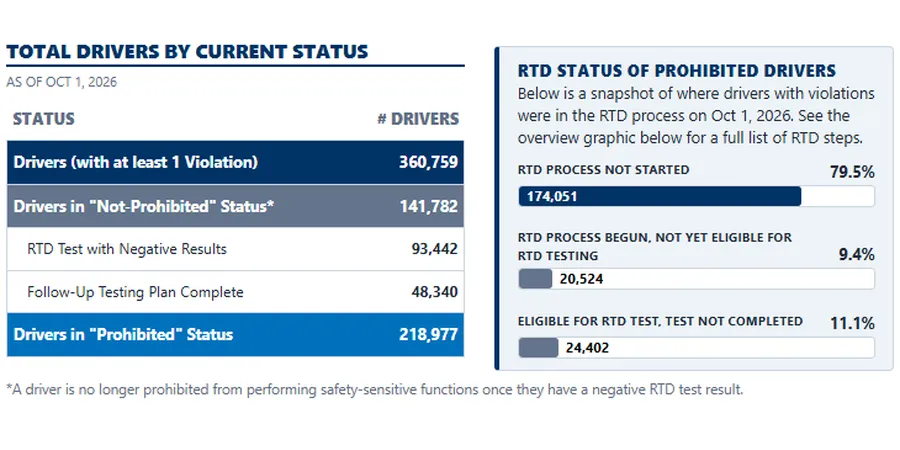
As of October 1, 2026, the Clearinghouse shows a total of 360,759 CDL/CLP drivers with at least one recorded drug or alcohol program violation. Of those:
218,977 drivers remain in "Prohibited" status, meaning they are legally barred from operating a CMV or performing any safety-sensitive function.
141,782 drivers have achieved "Not-Prohibited" status, either by completing a negative RTD test (93,442) or completing their full follow-up testing plan (48,340).
The sheer volume of prohibited drivers highlights why Clearinghouse queries are so critical. Hiring a driver in prohibited status, even unknowingly, can expose your company to significant liability and regulatory penalties.
The RTD Process Gap Is Still a Major Problem
Among the 218,977 drivers currently in prohibited status, the RTD process data paints a concerning picture:
79.5% (174,051 drivers) have not started the RTD process at all.
9.4% (20,524 drivers) have begun the process but are not yet eligible for RTD testing.
11.1% (24,402 drivers) are eligible for their RTD test but have not completed it.
The fact that nearly 80% of prohibited drivers haven't even initiated the RTD process is significant. It suggests many of these drivers have simply exited the regulated workforce rather than seeking reinstatement, but that doesn't eliminate the risk. Employers must still query these drivers before hiring and on an annual basis, because a driver's prohibited status follows them across employers.
A driver is no longer prohibited from performing safety-sensitive functions once they have a negative RTD test result. Until that point, any employer who allows a prohibited driver to operate is in violation of federal regulations.
Cumulative Violations Top 417,000 Since 2020
Since the Clearinghouse launched in January 2020, a total of 417,509 drug and alcohol program violations have been recorded, 407,074 drug-related and 10,435 alcohol-related. Violations peaked in 2022 at 70,040 and have been trending downward since. Through the first nine months of 2026, there are 41,246 violations recorded year-to-date, tracking below the full-year 2025 total of 58,130.
Violation Breakdown by Type
The breakdown of all-time violations by type shows that positive drug tests remain the dominant violation category:
Drug violations: 83.7% positive tests (340,890) | 14.7% refusals to test (60,009) | 1.5% actual knowledge (6,175)
Alcohol violations: 62.7% BAC over .04 (6,540) | 20.7% refusals to test (2,165) | 16.6% actual knowledge (1,730)
Notably, refusals to test account for nearly 15% of all drug violations. A refusal to test carries the same consequences as a positive result, immediate removal from safety-sensitive duties and mandatory RTD process, so employers should ensure their supervisors and testing coordinators are well-versed in what constitutes a refusal under 49 CFR Part 40.
Marijuana Remains the Most-Detected Substance
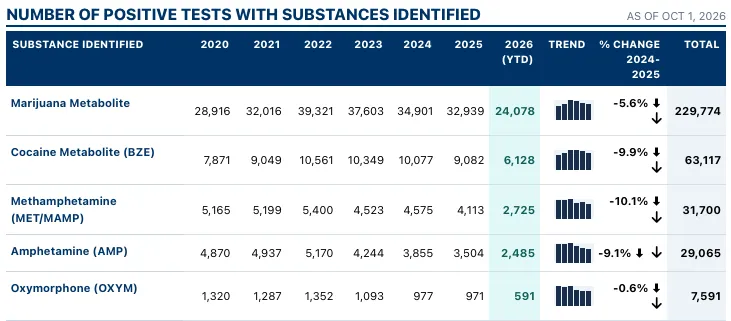
Looking at positive drug tests by substance, marijuana metabolite continues to top the list by a wide margin, with 229,774 cumulative detections since 2020. Cocaine metabolite (63,117) and methamphetamine (31,700) round out the top three. Key trends from 2024 to 2025 show most substances declining, with a few exceptions:
Ecstasy (MDMA) increased +4.8% year-over-year and is on a multi-year upward trend.
Oxycodone (+1.4%) and Hydromorphone (+2.7%) also saw modest increases, which may reflect broader opioid use trends.
6-Acetylmorphine (heroin) saw the steepest decline at -23.5%, continuing a strong downward trajectory.
Methamphetamine fell -10.1% and cocaine dropped -9.9%, continuing multi-year declines.
For fleets, these trends are a reminder that a robust random testing program, combined with reasonable suspicion training for supervisors, remains the frontline defense against substance-impaired driving. Check out our latest article on the impact of marijuana rescheduling on DOT drug testing.
Pre-Employment Tests Dominate Drug Test Volume
The September report also breaks down positive drug and alcohol tests by test type. Across all years since 2020, the cumulative totals are:
Pre-employment: 223,342 positive drug tests (by far the largest category)
Random: 129,233
Follow-up: 16,113
Post-accident: 16,252
Return-to-duty: 9,295
Reasonable suspicion: 6,664
The high pre-employment number is somewhat expected, as it reflects the volume of hiring activity and the fact that the Clearinghouse query requirement catches prohibited drivers before they can re-enter the workforce under a new employer. On the alcohol side, reasonable suspicion tests account for the second-largest category (2,329 total), which underscores the value of ongoing supervisor training.
Query Activity Continues to Grow
Since the Clearinghouse launched, employers have queried a cumulative total of 6,569,739 unique CDL/CLP drivers. Query volumes peaked in 2025 at 3,670,860 unique drivers queried for the year. Through September 2026, 2,731,749 unique drivers have already been queried year-to-date.
A notable shift is also visible in the type of queries being conducted. In 2020, limited (annual) queries made up 63% of total query volume. By 2026 YTD, that share has dropped to 49%, while pre-employment queries now account for 48%, nearly equal. This likely reflects the increasingly competitive hiring environment as carriers aggressively recruit drivers.
What This Means for Your Fleet
The September 2026 Clearinghouse report reinforces several compliance priorities that every carrier should have firmly in place:
Query before every hire. With over 218,000 drivers currently in prohibited status, a Clearinghouse pre-employment query is non-negotiable. A driver's prohibited status doesn't disappear when they change employers.
Conduct annual queries for all current CDL drivers. This is a federal requirement under 49 CFR Part 382, and the data shows that violations occur across all test types, including random and reasonable suspicion, not just at hiring.
Train supervisors on reasonable suspicion. Reasonable suspicion-triggered alcohol tests are the second most common alcohol violation category. Supervisors must be trained to recognize the signs of impairment and understand their obligations.
Know what constitutes a refusal. With nearly 60,000 cumulative refusals to test recorded, refusal-related violations are a significant compliance risk. Make sure your drug and alcohol policy clearly defines refusal and that employees understand the consequences.
Register and maintain your Clearinghouse account. The FMCSA has recently announced new identity verification requirements for Clearinghouse users. Ensure your account and your designated C/TPA's access remain active and up to date.
If you have questions about your Clearinghouse obligations, your current testing program, or how to handle a driver who appears in prohibited status, contact Trucksafe Consulting for a compliance review. Staying ahead of these requirements protects your drivers, your fleet, and your operating authority.
Source: FMCSA CDL Drug and Alcohol Clearinghouse September 2026 Monthly Report. Data as of October 1, 2026. All 2026 data reflects a year-to-date (YTD) partial analysis beginning January 2026 and updated monthly.
