
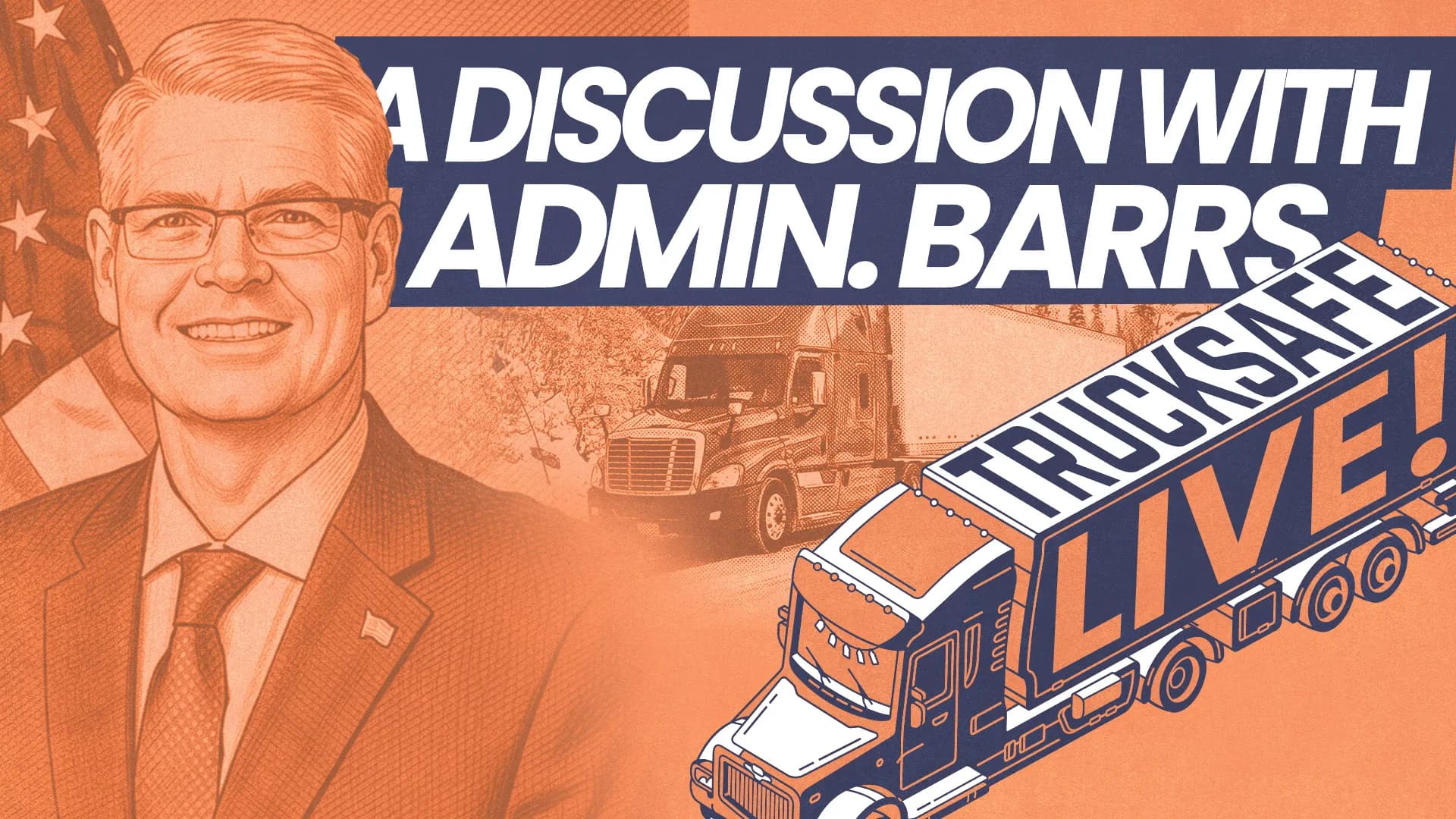
In our most recent episode of Trucksafe LIVE!, we were joined by FMCSA Administrator Derek Barrs to discuss the agency’s regulatory and enforcement priorities, the status of the MOTUS rollout, and more!
Special Guests
Derek Barrs — Administrator, FMCSA
Derek D. Barrs serves as the Administrator of the Federal Motor Carrier Safety Administration (FMCSA) within the U.S. Department of Transportation. Nominated by President Donald J. Trump on March 25, 2025, and confirmed by the U.S. Senate on October 7, 2025, he leads the agency’s mission to enhance commercial motor vehicle safety, improve the efficiency of the nation’s freight and passenger transportation systems, and bring commonsense principles to regulatory oversight.
Episode Summary
In Episode 63 of Trucksafe LIVE!, hosts Brandon Wiseman and Rob Carpenter of Trucksafe Consulting sit down with FMCSA Administrator Derek Barrs for a wide-ranging conversation on some of the most pressing issues facing the trucking industry. The discussion centers primarily on the agency's rollout of its new registration system, Motus, which has experienced significant technical difficulties since its Phase 2 launch. Administrator Barrs acknowledges the challenges openly, attributing many of the issues to decades of fragmented legacy data across seven separate FMCSA databases, some containing records dating back to the 1960s. Despite the rocky transition, Barrs emphasizes that modernizing the registration system was not optional and that the agency is meeting twice daily to address outstanding issues on a sprint basis.
Administrator Barrs provides important guidance for carriers and brokers experiencing problems with the new system. He notes that carriers who are currently showing active in the system and have no insurance issues are not required to proactively migrate into Motus at this time and can wait until their next MCS-150 update. For those experiencing difficulties, he encourages them to contact the agency directly or work through industry associations to submit batched issues for resolution. He also confirms that some carriers being blocked by the system are encountering intended friction, as the system is functioning as designed to flag incomplete or inaccurate information, a key feature aimed at combating carrier fraud, identity theft, and chameleon carrier activity.
The conversation also covers enforcement priorities, including the agency's ongoing removal of non-compliant electronic logging devices from the self-certified list. Administrator Barrs signals that future removals will be far more extensive than the recent batch of ten and reaffirms the administration's intent to eliminate the self-certification model entirely for both ELDs and entry-level driver training providers. He describes active rulemaking efforts in both areas and points to Canada and the UK as models the agency is studying as it considers third-party certification frameworks. Barrs also confirms that investigations of entry-level driver training schools are actively underway and will continue to ramp up.
Among the actionable takeaways for fleet safety professionals, Administrator Barrs and the hosts stress the critical importance of participating in the FMCSA rulemaking process by submitting comments during notice of proposed rulemaking periods. Barrs explicitly invites industry feedback on issues such as behind-the-wheel training requirements, online versus classroom instruction standards, and ELD certification processes, noting that every comment submitted is reviewed. He also encourages carriers experiencing Motus-related issues to contact the agency's call center, which has been expanded and now operates seven days a week with extended hours.
On broader agency matters, Barrs addresses the state of FMCSA's MCSAP partnerships, describing strong collaborative relationships with state enforcement partners and ongoing joint operations. He also touches on other unified agenda priorities, including changes to the safety rating process, new entrant safety audit standards, and CDL licensing reforms, including a push to require both written and practical CDL testing to be conducted in English. Throughout the conversation, Barrs expressed his interest in transparency and urgency, encapsulating his approach with the acknowledgment that the agency has "bitten off more than it can chew" but remains committed to continuing to work through the challenges in the interest of highway safety.
