
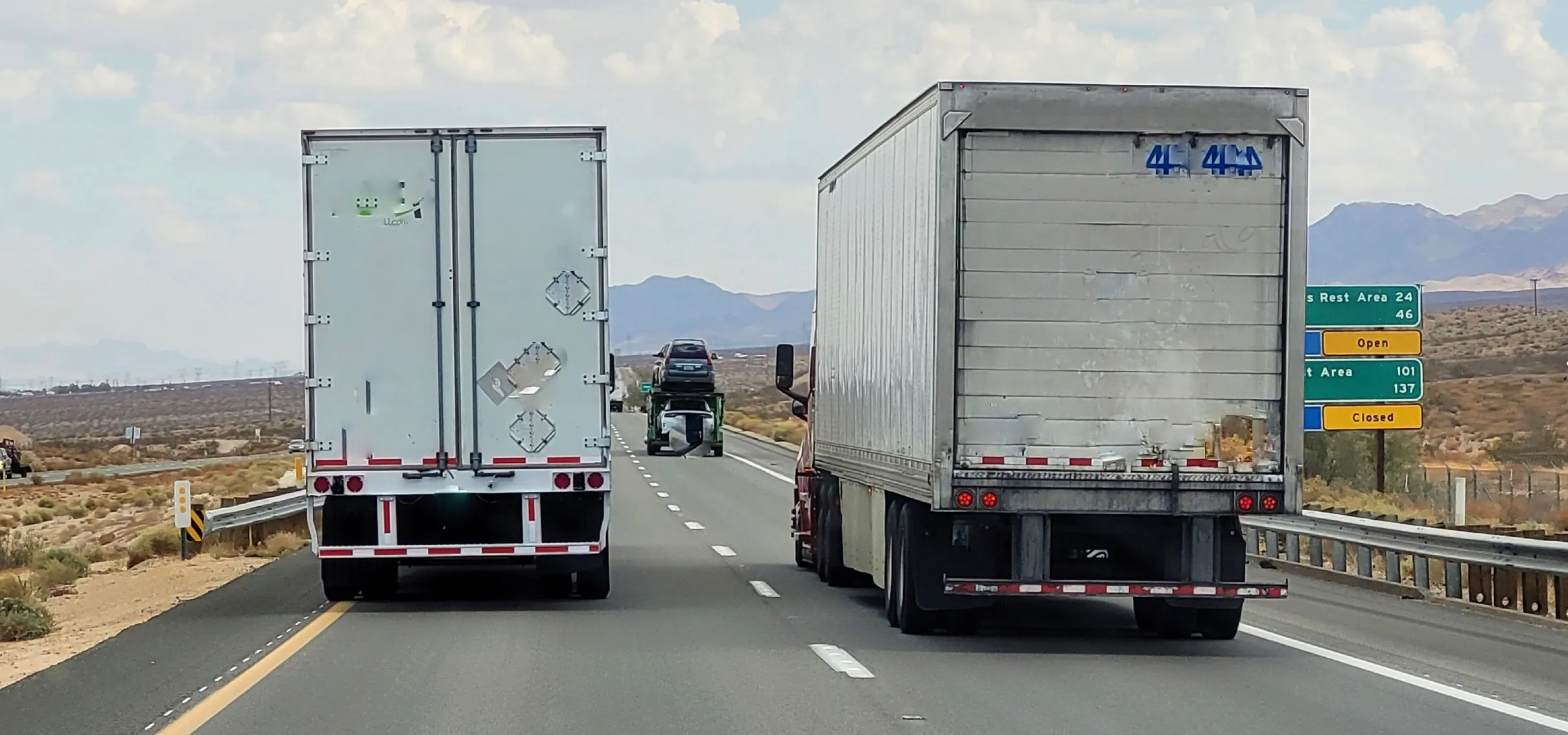
Cabotage is the transportation of freight between two points inside the United States by a foreign driver or foreign-based equipment. A Mexican or Canadian driver can haul a load into the United States and haul a load back out. That driver cannot pick up a load in Laredo and deliver it to Chicago, or pick up in Chicago and deliver to Atlanta. That second move is a domestic load, and federal immigration and customs law reserves it for drivers who are authorized to work here.
On November 10, 2026, the U.S. Attorney's Office for the Southern District of Texas announced the indictment of the owner of a Laredo trucking company for allegedly running more than a thousand domestic loads with drivers who held only B-1 business visitor status. Federal agencies are now sharing roadside data to find these operations, and the same enforcement push behind English Language Proficiency (ELP) out-of-service orders and the non-domiciled CDL rule is reaching cabotage.
This guide covers what cabotage is, which rules and agencies govern it, how it shows up at the roadside, and what carriers and brokers need to check.
The VMS Transport indictment
According to the Justice Department, Armando Martinez Varela, 56, of Laredo, owns VMS Transport LLC. Prosecutors allege that between February 20 and May 15 of this year, VMS used 57 drivers admitted under B-1 nonimmigrant status to run 1,044 domestic trips. The drivers allegedly picked up trailers in Laredo and delivered shipments throughout the United States, and Varela allegedly arranged housing for them between assignments rather than having them return to Mexico.
The government alleges VMS paid these drivers 25 to 50 cents per mile, compared with 70 cents for authorized drivers doing similar work, and saved about $299,606 in labor costs. Homeland Security Investigations (HSI) conducted the investigation. The indictment charges employing unauthorized workers, encouraging or inducing unlawful entry or residence, harboring aliens, and making materially false statements to federal investigators. The charges carry up to 10 years in federal prison and a fine of up to $250,000.
These are allegations. An indictment is a formal accusation, Varela is presumed innocent, and no plea or conviction has been reported as of this writing.
Two details from the coverage matter for everyone else in the supply chain. Overdrive reports that VMS holds active operating authority with 53 trucks and 50 drivers in FMCSA's Motus registration system. And Land Line reports, citing FMCSA data, that VMS drivers received nine ELP out-of-service violations across seven states. This was a registered U.S. carrier with active authority, running domestic freight across the country, and its inspection record carried warning signs.
The rules that govern cabotage
The cabotage prohibition comes from three directions: customs law for the equipment, immigration law for the driver, and FMCSA rules for the carrier's authority.
Customs: foreign-based equipment
U.S. Customs and Border Protection (CBP) regulates foreign-based trucks under 19 CFR 123.14. Foreign-based trucks admitted in international traffic "shall not engage in local traffic in the United States" unless an exception applies. The main exception allows a foreign truck to carry merchandise between U.S. points only when the move is incidental to the truck's immediately prior or subsequent international trip, such as a move in the general direction of an export load or as part of the truck's return to its home country. A violation exposes the carrier to penalties under section 592 of the Tariff Act of 1930 (19 U.S.C. 1592).
Immigration: the B-1 driver
Mexican and Canadian commercial drivers enter the United States as B-1 business visitors under the USMCA provisions in 8 CFR 214.2(b)(4). The regulation covers "transportation operators" in 8 CFR 214.2(b)(4)(i)(E)(1). These operators may make deliveries in the United States if the goods were loaded in Canada or Mexico, and they may load at U.S. locations if the goods will be delivered in Canada or Mexico. The regulation then draws the line:
Purely domestic service or solicitation, in competition with the United States operators, is not permitted.
Immigration law is stricter than customs law. CBP's guidance for land carriers addresses a driver hauling goods from the United States to Canada who wants to drop a domestic load at another U.S. point "since it is on the way." The answer is no: "For Immigration purposes, that is considered point-to-point hauling within the United States and is not permitted." The same guidance says a U.S. carrier may employ a foreign driver only for the international delivery of goods. Any domestic load requires U.S. employment authorization. As the Justice Department put it in the VMS release, B-1 status "does not authorize employment transporting freight solely within the United States."
Who the driver works for changes nothing. A B-1 driver behind the wheel of a U.S. carrier's truck, under that U.S. carrier's authority, is still barred from domestic loads. That is the core of the VMS case.
FMCSA: operating authority and commercial zones
FMCSA's rules reach cabotage through operating authority. Mexico-domiciled carriers that operate beyond the border commercial zones apply for authority under 49 CFR Part 365, Subpart E, and 49 CFR 365.501(b) limits what that authority covers:
A Mexico-domiciled carrier may not provide point-to-point transportation services, including express delivery services, within the United States for goods other than international cargo.
A carrier operating outside the scope of its authority violates 49 CFR 392.9a. Under 392.9a(b), the carrier "shall be ordered out of service" when it operates without required authority or beyond the scope of that authority, and it faces civil penalties under 49 U.S.C. 14901. A Mexico-domiciled carrier hauling a Dallas-to-Memphis load is operating beyond its authority.
Commercial zones add a separate boundary. Mexico-domiciled carriers with authority limited to the border commercial zones under 49 CFR Part 372 must stay inside those zones. Freight that moves past the zone into the interior falls outside that authority.
How cabotage gets caught: ELP, CDLs and shared data
The tools that surface cabotage at the roadside are driver qualification tools, and that is where the cabotage story connects to the rest of FMCSA's enforcement agenda.
English Language Proficiency
Under 49 CFR 391.11(b)(2), a driver must be able to "read and speak the English language sufficiently to converse with the general public," understand traffic signs, respond to official inquiries, and make entries on reports and records. Since June 25, 2025, drivers who fail that standard at roadside are placed out of service, under the enforcement policy FMCSA issued in May 2025 and revised in April 2026. FMCSA reported on November 4, 2026, that more than 33,000 drivers have been placed out of service for English or road-sign failures since April 2025. You can follow the monthly numbers on Trucksafe's ELP dashboard.
The border commercial zones are where ELP and cabotage meet. FMCSA's revised ELP roadside policy (MC-SEE-2026-0002, April 16, 2026) directs inspectors in a border commercial zone to "determine the scope of the driver's current trip before applying the OOS criteria." A driver who fails the ELP assessment on a trip that stays inside the zones is cited but not placed out of service. A driver on a trip that leaves the zones is placed out of service, and FMCSA's own example is a driver picking up a load at a Laredo, Texas warehouse for delivery to Detroit, Michigan. To decide which applies, inspectors use “bills of lading, dispatch records, equipment interchange receipts, driver statements, or other related shipping documents." Those are the same documents that show whether a load is domestic. FMCSA's August 2026 proposed rule would write that structure into 49 CFR 390.5 and 391.11. That proposal is still pending as of this writing.
Non-domiciled CDLs
FMCSA's non-domiciled CDL final rule has been in effect since March 2026. It limits non-domiciled CLPs and CDLs to holders of H-2A, H-2B and E-2 status, proven with an unexpired foreign passport and Form I-94, and it ends the use of Employment Authorization Documents for these credentials. The D.C. Circuit heard argument in the challenge to that rule, Rivera Lujan v. FMCSA, on September 15, 2026. A decision is pending, and the rule remains in force. Read our breakdown of FMCSA's guidance on the final rule for the details.
The non-domiciled CDL rule and cabotage answer different questions. The CDL rule decides who holds a U.S.-issued commercial license. Cabotage decides who may haul domestic freight. A Mexican driver holding a Licencia Federal de Conductor is licensed to drive a CMV in the United States in international commerce, and 49 CFR 383.23(b)(1) prohibits that driver from obtaining a non-domiciled CDL from a U.S. state. A valid Mexican license and a B-1 visa together authorize international moves. Neither one authorizes a domestic load.
For carriers, this means a driver's license file is only half of the question. A driver can hold a valid commercial license, pass a medical exam and clear a road test, and still be unable to lawfully haul a single domestic load.
Shared roadside data
The newest piece is data sharing between DOT and DHS. Transport Topics reported in August that the Department of Transportation began providing the Department of Homeland Security, including CBP, with FMCSA data on cabotage violations earlier this year, and that Border Patrol agents now have electronic access to DOT records showing prior cabotage violations from roadside inspections. A DOT spokesperson told Overdrive that the department is "leveraging data sharing with U.S. Customs and Border Protection" and that cabotage reports "now impact visa status."
CBP states the consequence for drivers directly. Its South Texas field office describes cabotage as "the domestic point to point U.S. carriage or hauling of goods in the U.S. by a B1 truck driver" and warns that it "is a violation of the terms of that visa and can result in the cancelation of that document." FMCSA's own enforcement operations now run alongside immigration enforcement. Its November 2026 Operation Highway Shield wave in Arkansas ran with HSI and ICE and referred 74 immigration violations for federal enforcement.
Where carriers stand
For a motor carrier, cabotage exposure falls into three buckets:
Criminal exposure for the company and its owners. The VMS charges are immigration crimes: employing unauthorized workers, harboring, inducing unlawful residence, and false statements. These carry prison time, on top of anything FMCSA does.
Out-of-service orders and lost equipment time. An ELP failure on a trip outside the border zone puts the driver out of service. A Mexico-domiciled carrier hauling domestic freight is operating beyond its authority under 392.9a, and the vehicle is placed out of service.
Customs penalties and lost drivers. CBP penalizes local traffic with foreign-based equipment under 19 U.S.C. 1592, and drivers found hauling domestic loads face visa revocation and loss of entry privileges.
What carriers should do:
Check work authorization for every domestic move. Every driver who hauls a domestic load needs U.S. employment authorization documented in your Form I-9 records. A B-1 visa is not work authorization.
Separate international and domestic dispatch. If you run cross-border freight with foreign drivers, build dispatch rules that keep those drivers on international loads only, and keep the shipping documents that prove it.
Audit your driver qualification files for ELP. Assess ELP before dispatch and document it. Our ELP resources walk through the process.
Watch your own inspection data. ELP out-of-service violations and operating-authority violations on your record are the same signals enforcement and brokers use to find cabotage.
Where brokers stand
The criminal charges in a case like VMS land on the carrier and its owners. Brokers face the commercial and civil fallout: loads stranded at an out-of-service order, shippers asking why their freight sat in a yard, and, after the Supreme Court's decision in Montgomery v. Caribe Transport II, negligent selection claims when a crash follows. Our guide to broker liability after Montgomery explains how those claims work. A plaintiff's lawyer who learns the carrier was running domestic loads with drivers barred from domestic work, and that the warning signs sat in public FMCSA data, has an easy story to tell a jury.
Red flags in carrier vetting:
Domicile and authority that don't fit the lane. A Mexico-domiciled carrier on SAFER bidding on a lane that starts and ends in the United States is a cabotage move by definition. Mexico-domiciled authority covers international cargo only.
ELP out-of-service violations. ELP violations recorded in interior states show a carrier's drivers running freight far from the border.
Rates far below market. The VMS allegations center on paying drivers half the going rate. A carrier that consistently undercuts every other bid on a domestic lane is cutting cost somewhere.
Laredo and other border origins feeding domestic reloads. A carrier that delivers out of a border city and then takes a chain of domestic reloads without returning to the border fits the pattern alleged in the VMS case.
Fleet data that doesn't add up. Driver counts, power units and mileage on the MCS-150 that don't match the carrier's activity, or a carrier that can't name a domicile terminal for its drivers.
What brokers should check and document:
Carrier domicile and authority type on SAFER and Licensing & Insurance for every carrier you book on a domestic lane.
Inspection history for ELP and operating-authority violations, not just the out-of-service rate.
Contract terms. Your broker-carrier agreement should include the carrier's representation that every driver it dispatches on a domestic load is legally authorized to work in the United States and holds proper credentials for the move, plus the right to remove the carrier from your approved list if that representation proves false.
Your response. When a red flag appears, record what you saw, what you asked the carrier, and what you decided. That record is what you produce in discovery.
Reading SAFER snapshots, authority records and inspection histories well is a skill your carrier team builds through training. Trucksafe's Carrier Safety & Compliance for Brokers and Shippers course teaches carrier sales reps, compliance analysts and logistics managers how to read that data, spot chameleon and high-risk carriers, and document their vetting decisions.
The bottom line
Cabotage is simple to define and expensive to get wrong. Foreign drivers and foreign equipment haul international freight. Domestic freight requires drivers authorized to work in the United States, and carriers with authority that covers the move. Federal agencies now connect roadside inspections, ELP enforcement, licensing records and immigration data, so a cabotage operation that once ran quietly now surfaces at the roadside.
Brokers and shippers who want their teams vetting carriers against these risks should enroll them in Carrier Safety & Compliance for Brokers and Shippers. The course runs about seven hours across 11 chapters, includes a certificate, and offers team pricing for whole departments.
